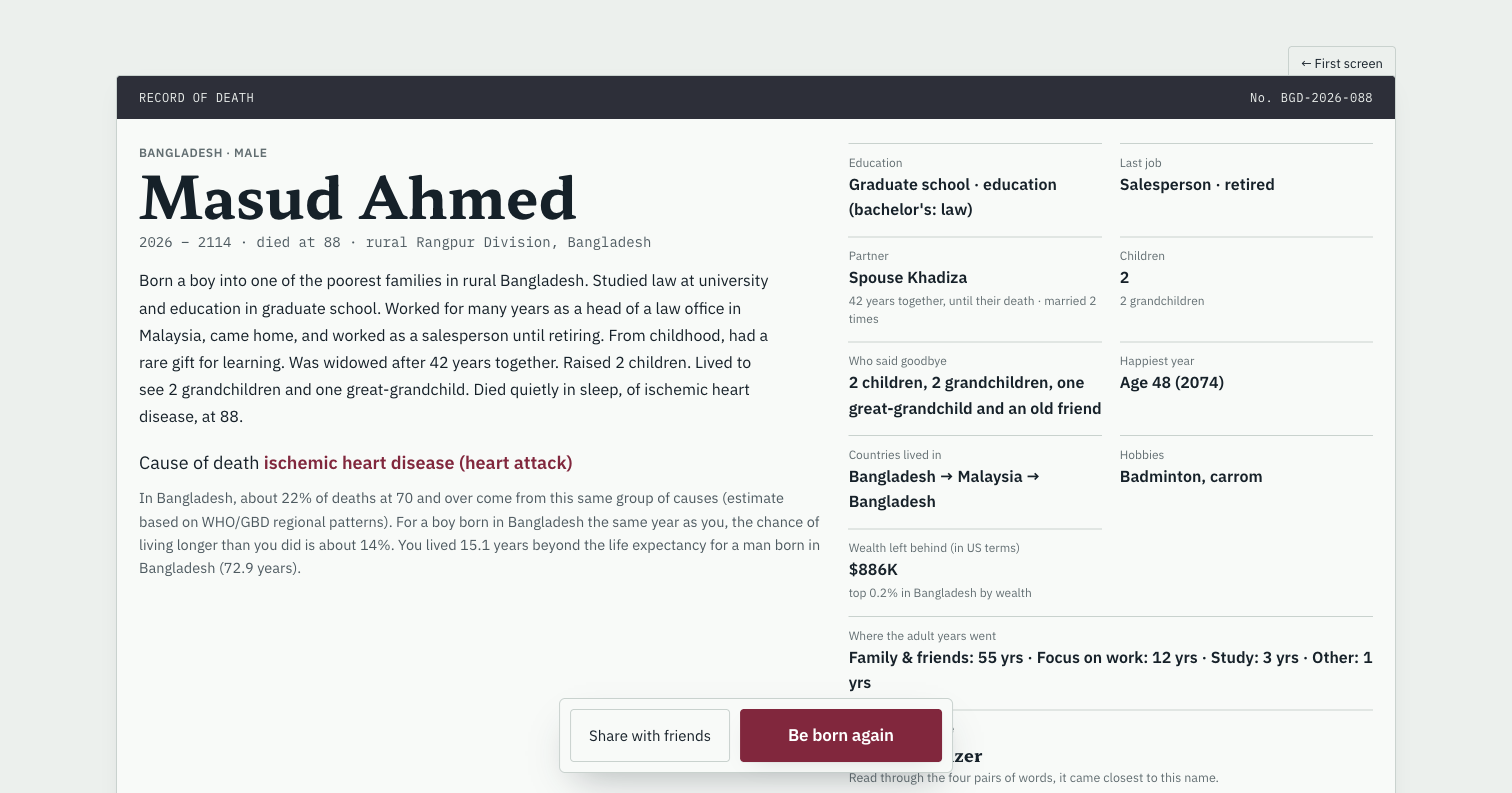
Masud’s completed life ended in 2114 with wealth displayed as $886K. Follow the actual choices, failed expansion, business closure and return home—not a guaranteed success route.
0–24: school, debt and a first job
Masud was born in rural Bangladesh in 2026, among the poorest 20% of families. Auto mode covered ages 0–7 and briefly 31; most later decisions were manual. We continued school at 12 and 15. At 18, knowledge 97 still meant only about-even university odds. Domestic admission succeeded; overseas study needed roughly $95K.
We chose law at 19. He graduated at 22 after debt and reduced meals. Selecting stocks at 21 explicitly did not borrow to invest. The lawyer offer at 23 paid $16,391 yearly; debts were cleared that age. At 24 we observed $2,677 savings and a 37% stock crash.
26–36: a first business, divorce and migration
Research at 26 led to a partner-financed law office at 27, costing $6,091. We married Jannat, had Ruma at 29 and expanded for about $17K at 31. The first ten-year stock review reported a $9,287 loss.
Long workdays wore Masud out. Counseling failed at 35; after divorce we chose to raise Ruma. Researching foreign work cost $116. At 36 we chose Malaysia for about $9,500 with the child. The office handover yielded $231K, but arrival left him jobless.
37–45: rebuilding work and buying a rental
At 37 we accepted teacher, bought a roughly $71K rental plus $2,143 costs and paid $7,820 for graduate study. We manually enabled annual checkups and healthier eating. Pneumonia needed hospital care; stocks crashed 49%.
The record places the education master’s completion at 38. At 39 we switched to accounting/finance; at 40 we started a second law office using savings. It expanded at 45. Rental value and spendable savings remained separate parts of wealth.
46–51: remarriage and losing $295K
We married Khadiza at 46; she brought $98K savings and her child. We bought our home at 47. At 49, net worth was $591,797, personal yearly income $204,974 and spouse income $71,596.
A $295K expansion toward managing partner then failed, losing the whole outlay. Masud remained senior partner. At 51 the rental stayed empty for six months after its tenant left. Neither asset guaranteed uninterrupted returns.
57–61: a crash, closure and retirement
Net worth reached an observed $936,310 at 57. Recession, a 47% stock crash and falling work followed. The age 58 panel showed $357K stock losses and $566,516 net worth. The office closed at 58; at 59 we accepted salesperson at $14,877 yearly.
Hypertension appeared at 60 despite the health routine; we chose medication and lifestyle changes. At 61 we retired. The card showed no pension and about $434 monthly help from an adult child. Peak career pay could no longer fund the budget.
84–88: returning home and the final record
At 84 we chose to let the Malaysian home and return to Bangladesh. By 86 the panel showed two rentals. Masud died in rural Rangpur at 88 in 2114 from ischemic heart disease. Wealth left behind was displayed as $886K, rounded, ranking in Bangladesh’s top 0.2%.
The ending compares him with the male Bangladesh baseline of 72.9 years: 15.1 years longer, with about 14% of the same cohort living beyond 88. These are the game’s sex-specific comparisons.
What mattered beyond the money
Khadiza died after 42 years together. The ending recorded 2 children, 2 grandchildren and 1 great-grandchild; age 48 was the happiest year. Adult focus totaled 55 years Family & friends, 12 Work, 3 Study and 1 Other.
The completed run demonstrates choices and trade-offs, not a reproducible fortune. A strong business exit, a total expansion loss, family support and decades of social focus all belong in its explanation. It did not end as a millionaire or billionaire.
Sources & verification
Observed in game · Oct 20, 2026 · v0.7.82 beta
A guide to the original .life game. Choices change probabilities; no route guarantees an outcome.